Meatloaf Wellington

- 1 large sheet frozen puff pastry, thawed (approximately 375g) such as ‘Careme All Butter Puff Pastry’ (or 2 sheets of puff pastry if braiding the pastry)
- 2 tablespoons extra virgin olive oil
- 1 clove garlic, crushed
- 500g frozen spinach, thawed
- 250g mozzarella
- Sea salt, to taste
- 4 tablespoons canola oil
- 4 eggs
- 1/2 cup (125ml) milk
- Salt to taste
- 30g dried breadcrumbs
- 60ml milk
- 400g beef mince (ground meat)
- 300g pork mince (ground meat)
- 1 egg
- 30g Parmigiano Reggiano cheese (alternatively Grana Padano), finely grated
- 1 tablespoon sage, finely chopped
- Sea salt to taste
- 1 egg
- 2 tablespoons milk
Place the olive oil in a large frying pan and heat over medium heat. Add the garlic and cook for 1 minute. Add the spinach and toss for 3 minutes or until fragrant. Place the cooked spinach into a mesh strainer. Use the back of a ladle to press down and strain the liquid from the spinach. Alternatively, squeeze the spinach with your hands to extract as much liquid as possible. Set the spinach aside to cool.
Optional step – to make the two thin frittatas, whisk the eggs, milk and sea salt in a mixing bowl. Heat half of the canola oil in a large frying pan. Add half of the frittata mixture and spread to cover the base in a thin film. Cook frittata for about 2 minutes or until the underside is cooked. Use a spatula to flip the frittata, then cook on other side for 1 minute or until cooked.
Tip: The frittata is a thin omelette-style egg layer that acts as a barrier to catch any moisture that the meat has released during cooking. It is optional, however without the egg barrier, any liquid released from the meat will seep into the pastry.
To make the meat filling, place the breadcrumbs in a large bowl and pour the milk over to soak for a few minutes. Add the beef and pork mince (ground meat), egg, Parmigiano Reggiano (or Grana Padano) and sage. Season with salt, then use your hands (or you may wish to use disposable gloves), to mix until well combined.
Place a large rectangular piece of baking paper on a clean work surface. Spoon the meat filling onto the baking sheet. Use a metal spoon to press the meat filling into a large rectangle shape of about 1cm thickness.
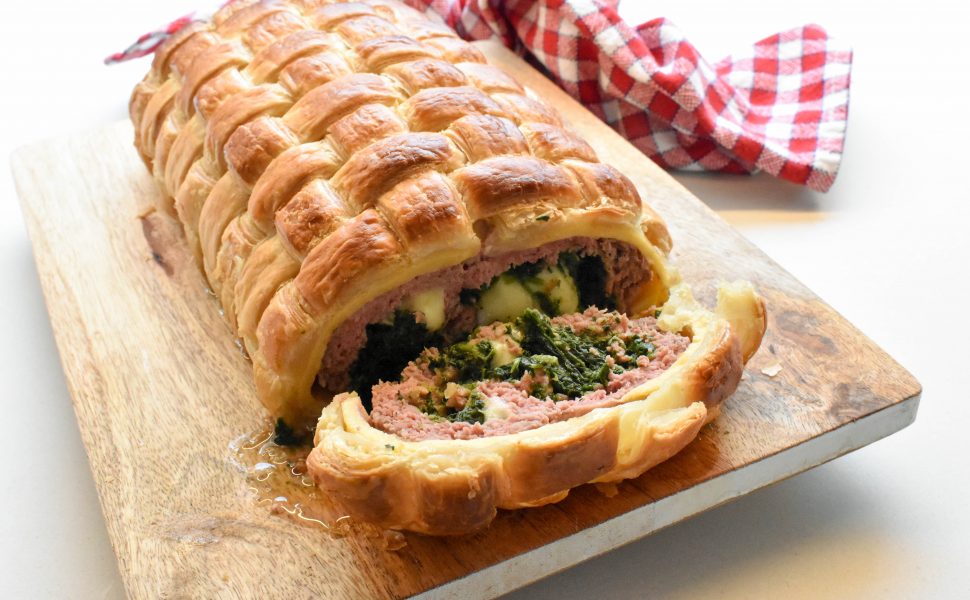
Arrange the spinach evenly over the meat filling leaving a 1cm border around the edges. Arrange the chopped mozzarella over the spinach layer, also leaving a 1cm border around the edges.
Use the baking paper to roll the meatloaf from the short end to enclose the filling. Smooth the middle joint and ends of the rolled meat mixture. Leave covered in baking paper and refrigerate until ready to use.
For a plain puff pastry crust (without braiding), unroll 1 sheet puff pastry, keeping it on the parchment paper. Use a rolling pin to flatten the puff pastry sheet slightly. Refrigerate for 30 minutes.
Instead to make a braided crust for the meatloaf, unroll two puff pastry sheets, keeping them on the parchment paper. Use a rolling pin to flatten each puff pastry sheet slightly. Cut both puff pastry sheets lengthwise into 1.5 cm strips with a sharp knife. Place one sheet of puff pastry onto a shallow baking tray. Leave a border at the top of about 2cm. Lift every second strip to the 2cm border. Place a strip of pastry from the second puff pastry sheet horizontally, immediately below the lifted strips. Lower all the raised strips. Lift every second of the opposite strips i.e. those that you left down in the previous row. Place a strip of pastry from the second puff pastry sheet horizontally, then lower all raised strips. Repeat, alternating the lifting of strips and adding a horizontal puff pastry sheet until all the pastry strips are woven into a braid. Refrigerate the braid for 30 minutes.
Note: The pastry needs to be cold to arrange over the meatloaf.
Preheat the oven to 200°C (400°F / Gas Mark 6) using a conventional oven setting.
Remove the meatloaf from the fridge. Lay the two frittatas on a sheet of plastic wrap, overlapping each other slightly. Place the meatloaf in the centre of the frittata. Use the plastic wrap to roll the frittata tightly around the meatloaf to cover.
After chilling the puff pastry, place the meatloaf in the centre of the puff pastry and roll so that the pastry completely covers it, making it as tight and neat as possible. Press the seams of the pastry to make a seal and roll so that it is seam side down. Tuck the sides of the puff pastry to enclose the filling and trim off any excess pastry.
Use a fork to lightly beat the egg and milk in a small bowl. Brush the puff pastry with the beaten egg mixture. Bake for 20 minutes, then reduce the oven temperature to 180°C (350°F / Gas Mark 4) using a conventional oven setting. Watch the Meatloaf Wellington closely, and if the crust begins to brown too quickly, shift it to a lower rack in the oven. Bake for a further 45 minutes, or until cooked through.
Tip: You can remove the meatloaf from the oven when it reads about 68°C (155°F) as it will continue cooking as it rests. The safe internal temperature of meatloaf is 71°C (160°F) when measured with a probe thermometer. This ensures the ground meat is fully cooked and safe to eat
Allow the meatloaf to cool for 10 minutes before slicing to serve – buon appetito.